
MUSCLE STRENGTH AND FATIGUE TESTING
The LifeForce QMA Series Isokinetic Testing and Evaluation System is a
tool that will provide objective substantiation and documentation of your
patient's progresss through therapy. You may find it to be beneficial
in research when applied to drug therapy, fatigue studies or compiling
population normals.
The QMA System is registered with the FDA
as a Class II
medical device:
REGISTRATION
In Research
QMA is currently the muscle assessment system
of choice in university hospitals, clinics and
institutions in Europe, the Middle East, and
North America - Canada and the United States,
in the continuing research of neuromuscular
and motor neuron diseases.
Several articles are published each year
in peer review publications from
research utilizing the QMA System.
Published articles and referrals may be viewed
at the following:
Publications
In Healthcare
QMA is used by healthcare professionals to evaluate the
physical rehabilitative progress and functional capacity of patients, to document the percentage change from a previous
visit and to compare each muscle or muscle group tested to an expected "normal"
- based on age, gender, and body mass index (BMI).
Reports may be generated that compare your patients?visit to a
previous or baseline visit, and include the measured effort and the
percentage change of each muscle tested.
Calculations may also be made comparing your patients?
efforts to those of a theoretical
QMA provides documentation in the diagnosis
of neuromuscular systemic diseases; such as, Amyotrophic Lateral Sclerosis
(ALS), Myasthenia Gravis (MG) and Myotonic Dystrophy, where the primary indicators are
loss of muscle strength (muscle atrophy) and excess fatigue.
Early utilization of QMA may confirm the diagnosis in initial stages.
Diagnostic and assessment of swallowing and speech impediment may be
assisted with tongue strength instrumentation. May be used
with stroke patients to measure their rate of recovery.
Hand Held Myometry -
Hand
held input instruments with analog output (HHM) may be used to replicate manual muscle testing
(MMT). Categories
of tests include strength, and static and dynamic fatigue.
HHM provides an increased range of muscles and muscle groups to be
tested and assessed than fixed myometry.
When HHM is utilized to
assess larger
muscle(s) or muscle groups, accuracy may be
compromised due to the point of
resistance established and maintained by the tester being moved or
compromised.
<More>
Fixed Myometry
-
Preferred when testing larger muscles or muscle groups, or muscle fatigue. Tests may be constructed, conducted and analyzed on any
muscle or muscle group that can be isolated
and effort exerted against a fixed point. Categories of tests include strength
and static and dynamic fatigue.
<More>
-
Hand Grip Strength, Hand Held Myometry input equipment and a Netbook or
Notebook - complete, portable, accurate and easy to use. Complete
documentation of your patients progress with your comments and evaluation
makes this a complete assessing system.
<More>
Components of the system
describes and illustrates components of the QMA system.
Hand Grip - A hand dynamometer with analog output to measure hand grip strength and fatigue.
Hand Held
Myometry (HHM) Unit - Permits the testing personnel to assess most muscles
or muscle groups, replicating manual muscle testing (MMT).
Pinch Test - Key, Tip and Palmar strength and fatigue with analog output.
Individual Finger Strength - adjustable from 1" to > 4" from 1 to 100 Lbf instrument with analog output.
Tongue Appliance
- Test tongue strength with analog output. (Speech Impediment and Bulbar
paralysis)
Timed Test - Integrated stopwatch acquires
elapsed time
of test, (i.e. three stair climb, etc.)
Direct Data Input - Other data may be entered as a test - examples,
include: blood pressure, weight, height, any
required or desired data taken during the visit.
Electronic
Medical Reporting - Patient
Evaluation and Progress Documentation
-
Complete professional
reports are automatically populated for patient evaluation: Document the longitudinal rehabilitative progress of your patients,
automatically calculates percentage change from previous visits, and
anticipated "normal" based on age, gender & BMI, and
percentage deviation from normal.
US and European formats are illustrated.
DATA MANAGEMENT
EXPORT TO EXCEL INFO & EXAMPLES All acquired data may be compiled, queried, and exported
seamlessly to MS Excel
for comparative longitudinal analysis.
COMPLETE YOUR TESTING AREA
Electric HI/lo Examination tables,
Zimmer orthopedic traction
equipment,
PC or Notebook computers and components.
SECURE CLIENT WEBSITE
(Clients) - A secure
website (password
protected) is available for your use - store and transfer protocol
data, download new QMA releases, share thoughts, and helpful
hints for using the QMA software to its fullest potential with other QMA users. If
you currently use the QMA system, please request a username and password.
Request access.
Upon validation, access to the client web site will be emailed to you.
QMA FIXED
MYOMETRY
TESTING AREA

Click
to Enlarge Photo
==============
QMA HAND HELD MYOMETRY &
PORTABLE SYSTEM

PATIENT
PROGRESS REPORT
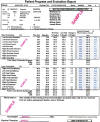
Click to Enlarge Photo
---------------------

